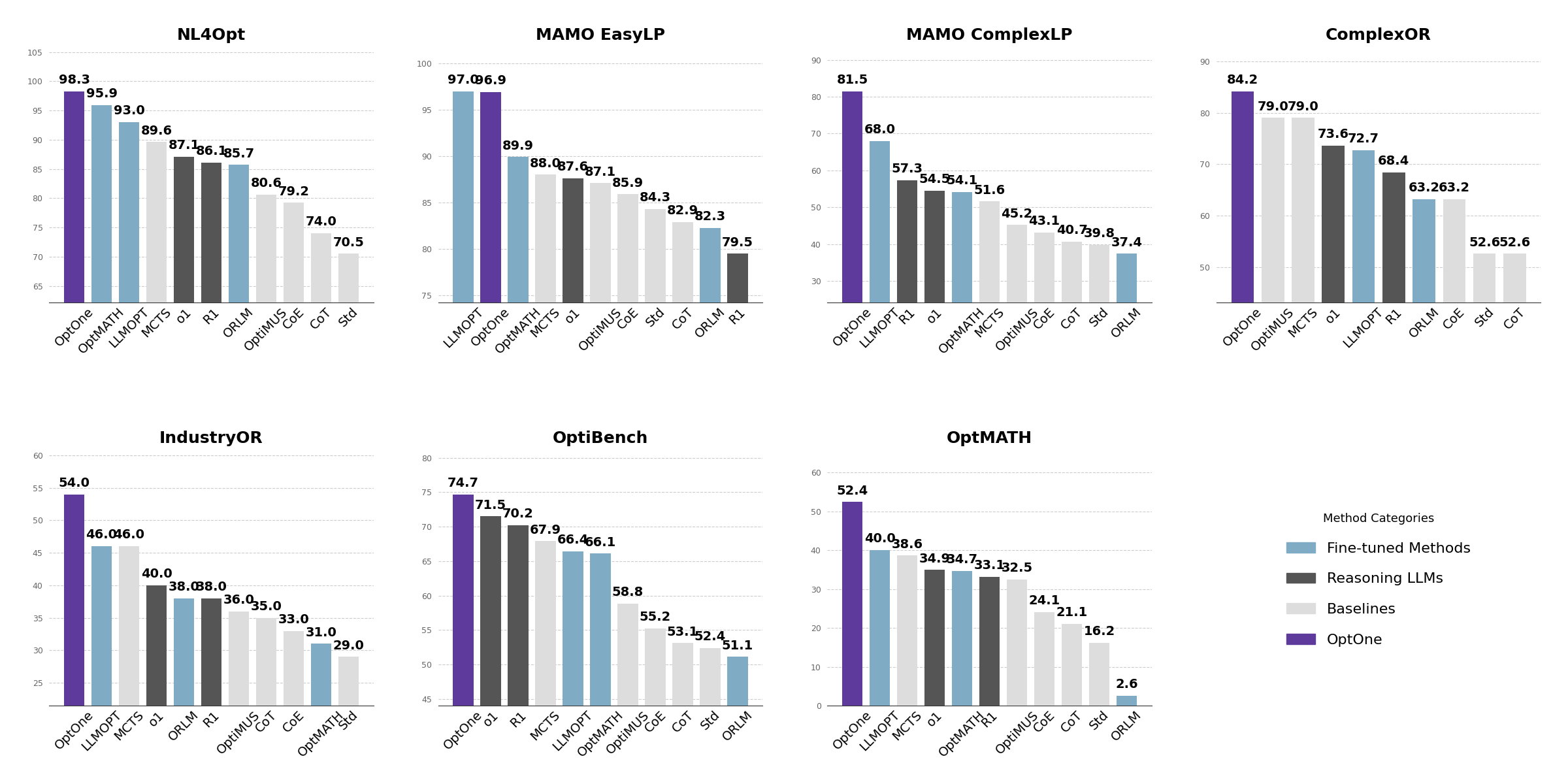
The overview performance of OptOne
From Passive Reasoning to Active Evolution—The Agentic System for Real-World Mathematical Problems.
Introduction
Operations Research (OR) is a critical part that powers efficient decision-making across modern industry and the global economy. It provides the mathematical and analytical framework behind essential activities like coordinating global supply chains, maintaining stable energy networks, and refining financial investment strategies, delivering data-driven insights for high-impact business and operational choices. Yet the field has long faced a major barrier: real-world business challenges are described in unstructured, everyday language, while optimization tools require precise, error-free mathematical code to generate valid solutions. For decades, we relied on highly specialized experts to translate vague business requirements into rigorous mathematical equations, which is a slow, costly process.
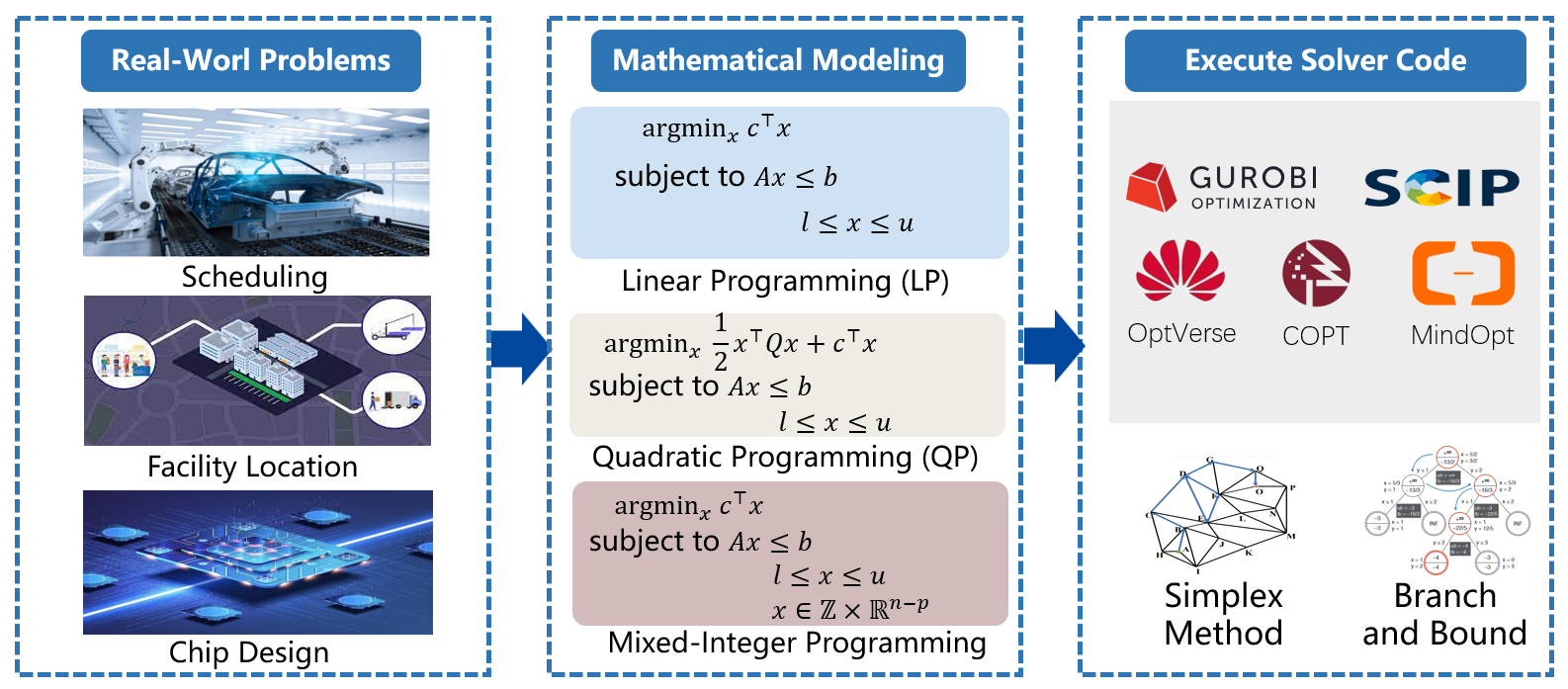
The solving process of the real-world mathematical problems
Large Language Models (LLM) now offer a transformative opportunity to overcome this barrier. For the first time, we have a technology capable of deeply understanding the nuances of human language and generating complex code. This progress could democratize access to advanced decision science: a logistics manager could simply describe a shipping route challenge, and an AI system would immediately build the mathematical model needed to solve it. However, standard Large Language Models operate on probabilistic principles, acting as creative content generators, while optimization is a field built on strict logical rules. While recent Large Language Models have demonstrated linguistic fluency, they fundamentally struggle with the rigorous logic, domain-specific knowledge gaps, and structural complexity required for OR modeling. OptOne represents a paradigm shift in this landscape. It is not merely a language model trained on code; it is a holistic, evolutionary intelligent agent designed to master the art of optimization. We are moving beyond basic text generation to Automated Optimization Modeling, developing intelligent systems that combine AI’s natural language proficiency with the mathematical precision required to manage the world’s most complex industrial and economic systems.
The Challenge
The fundamental bottleneck in applying Generative AI to Operations Research is the incompatibility between the probabilistic nature of LLMs and the rigorous and knowledge-intensive natures of the real-world mathematical problems. When a standard LLM attempts to solve a complex industrial scheduling problem, it often struggles from the background knowledge insufficiency and failure in applying advanced mathematical techniques. These models tend to hallucinate plausible-sounding but mathematically invalid constraints, fail to maintain logical consistency across long reasoning chains. We require a system that mimics the cognitive processes of a human OR expert: one that knows how to decompose problems, where to look for missing information, how to learn from simpler tasks, and how to rigorously verify its own work before submission, how to accumulate experieces from the historial problems.
The Architecture: Five Critical Features in OptOne
1. OptiTree: The RAG Module with Hierarchical Problem Decomposition
At the core of OptOne is the ability to simplify complexity. Real-world optimization challenges are rarely simple; they are often composed of many interconnected parts that confuse standard models. Instead of attempting to solve these complex problems in a single linear step, OptOne employs OptiTree, a tree-search mechanism that mimics structured human reasoning. By organizing optimization problems into a clear hierarchy, the system adaptively breaks down a difficult query into manageable sub-problems—for example, deconstructing a complex logistics challenge into distinct “vehicle routing” and “bin packing” tasks. Once decomposed, the agent retrieves and reuses proven “modeling thoughts” for each specific sub-task from its knowledge base. By assembling these verified building blocks, OptOne synthesizes a robust global solution, ensuring the mathematical model remains accurate even as problem complexity increases.
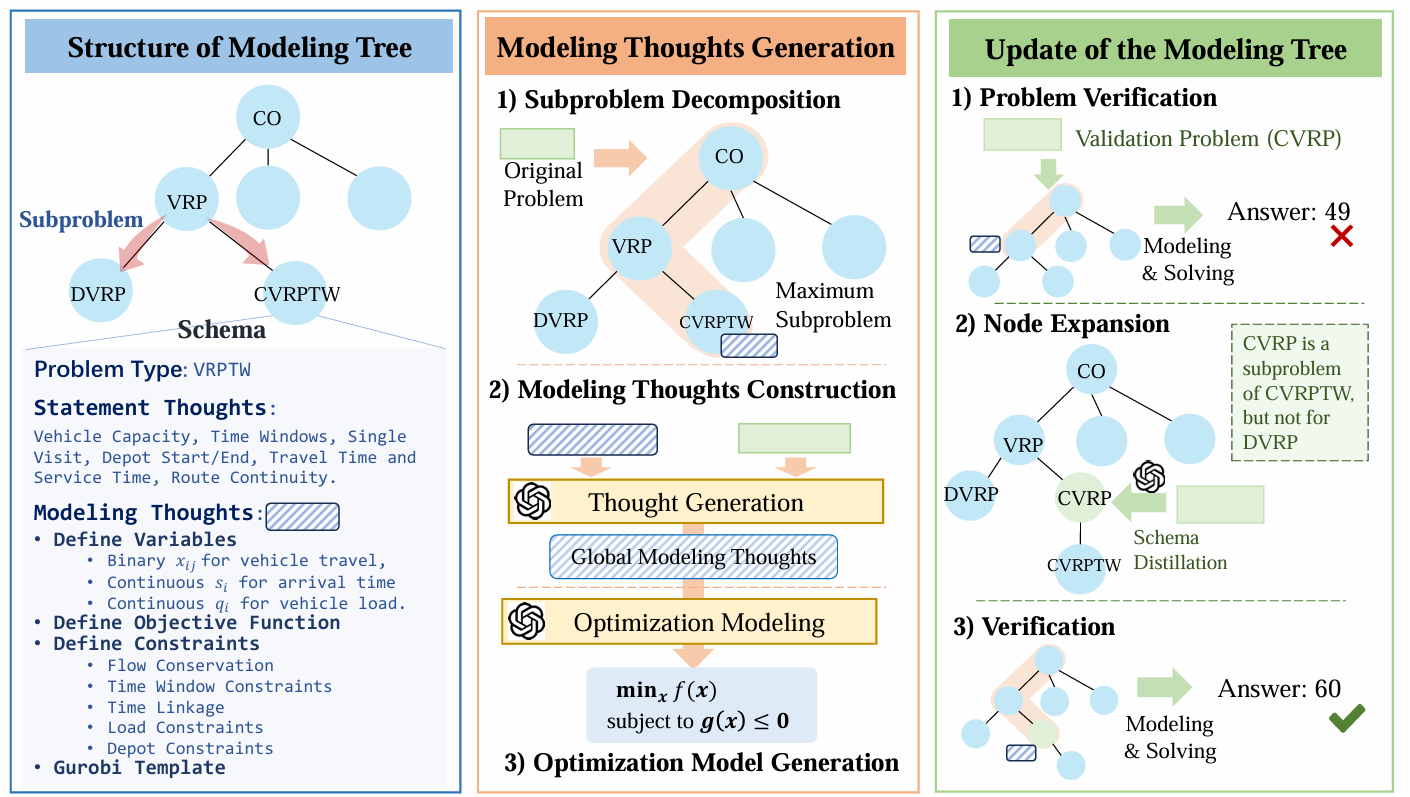
Illustration of OptiTree
2. Opt-Miner: The DeepResearch Module to Mitigate the Knowledge Gap
Even the most advanced models have limits to their internal knowledge. When standard LLMs face unfamiliar industrial rules or technical syntax, they often guess, leading to “hallucinations.” OptOne takes a different approach with Opt-Miner, an active research module driven by R-GRPO (a specialized reinforcement learning technique for DeepResearch). Instead of generating code blindly, OptOne first identifies what it doesn’t know. It then autonomously searches external documentation and the web to retrieve precise details—whether it is specific cargo safety regulations or obscure solver commands. By “mining” for the missing knowledge and usage of mathematical techniques before solving, OptOne transforms from a passive text generator into an active researcher, ensuring every mathematical constraint is grounded in verified reality.
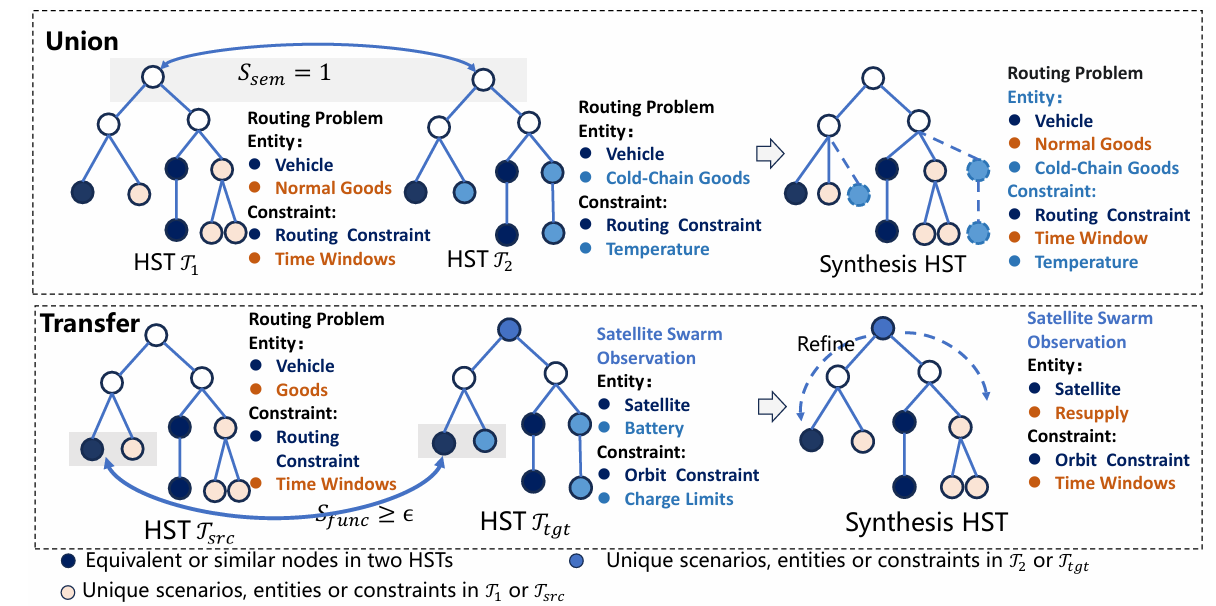
Data generation process for DeepResearch
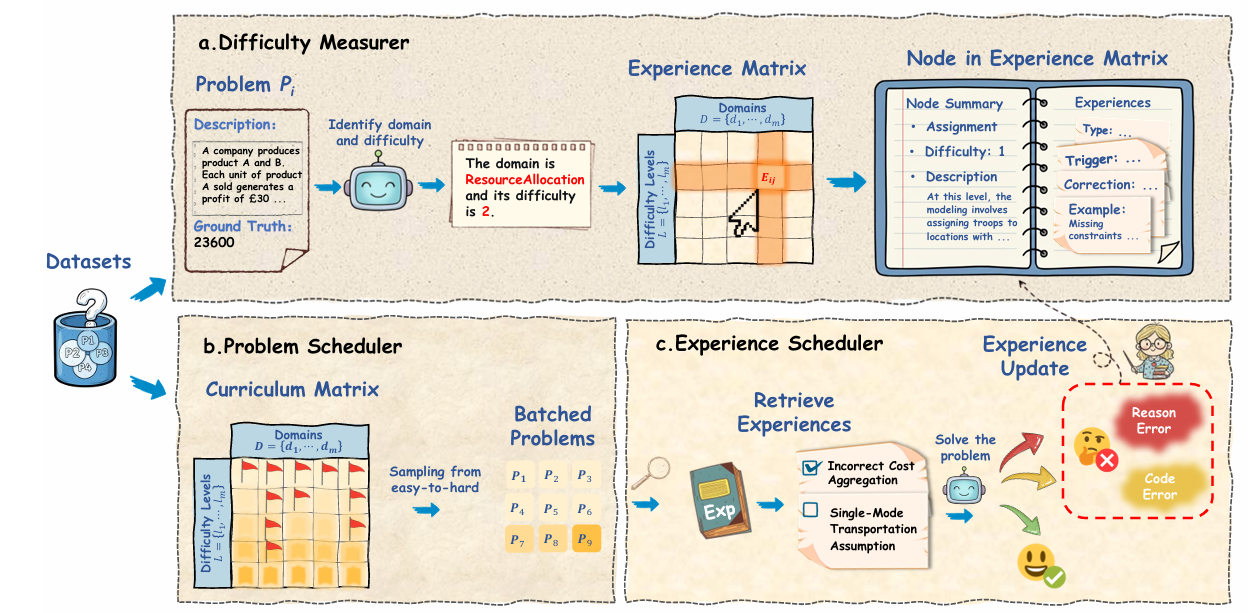
3. OptClimber: The Self-Evolving Module with Curriculum Experience Learning
Intelligence is cultivated, not just programmed. OptOne achieves its self-evolution through OptClimber, a module that mimics human learning that accumulate the experience from its past problem-solving trajectories. Just as a student must master arithmetic before tackling calculus, OptOne follows a structured path. It organizes training tasks into a “Curriculum Matrix” based on their difficulty. A specialized scheduler then guides the model step-by-step: starting with simple, fundamental exercises and progressively advancing to complex, multi-objective industrial challenges. This “easy-to-hard” approach prevents the model from being overwhelmed by noisy, difficult data in the early stages. By steadily “climbing” this ladder of complexity, OptOne builds a solid logical foundation, allowing it to eventually solve hard problems that were previously impossible.
4. Opt-Aligner: Two-Stage Experience Transfer for Cost-Effiective Deployment
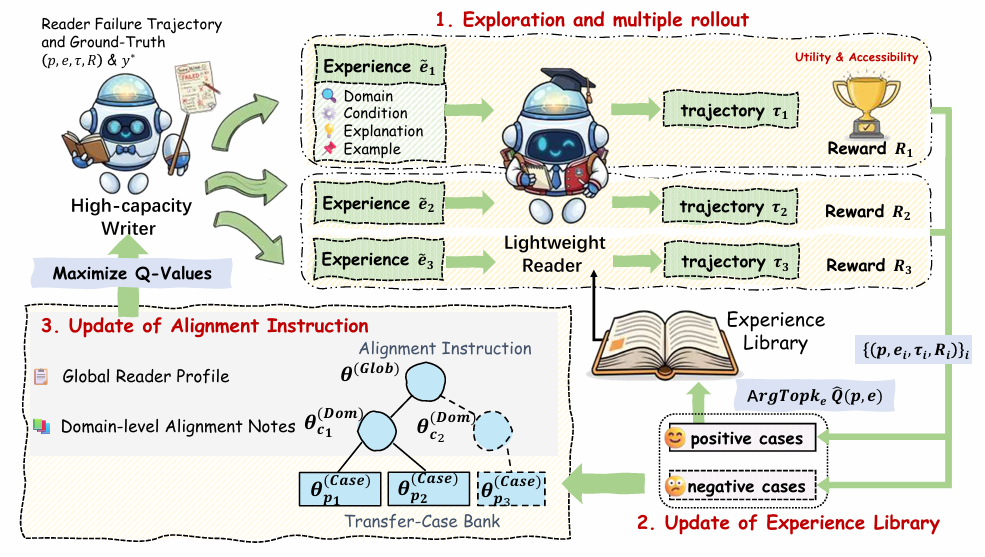
To maximize efficiency, OptOne closes the gap between massive “Teacher” models and smaller “Student” models using Opt-Aligner. In traditional systems, smart models often fail to teach effectively because their explanations are too abstract for smaller models to grasp—a problem we call “Cognitive Misalignment.” Opt-Aligner solves this by treating learning as a two-way dialogue. It forces the stronger “Writer” (Teacher) to adjust its teaching style, translating complex logic into clear, step-by-step instructions that the weaker “Reader” (Student) can easily absorb. This ensures that the deep intelligence of a giant model is effectively compressed into a lightweight, fast agent, delivering state-of-the-art performance at a fraction of the cost.
5. Opt-Verifier: The Self-Correction Module for Reliable Solutions
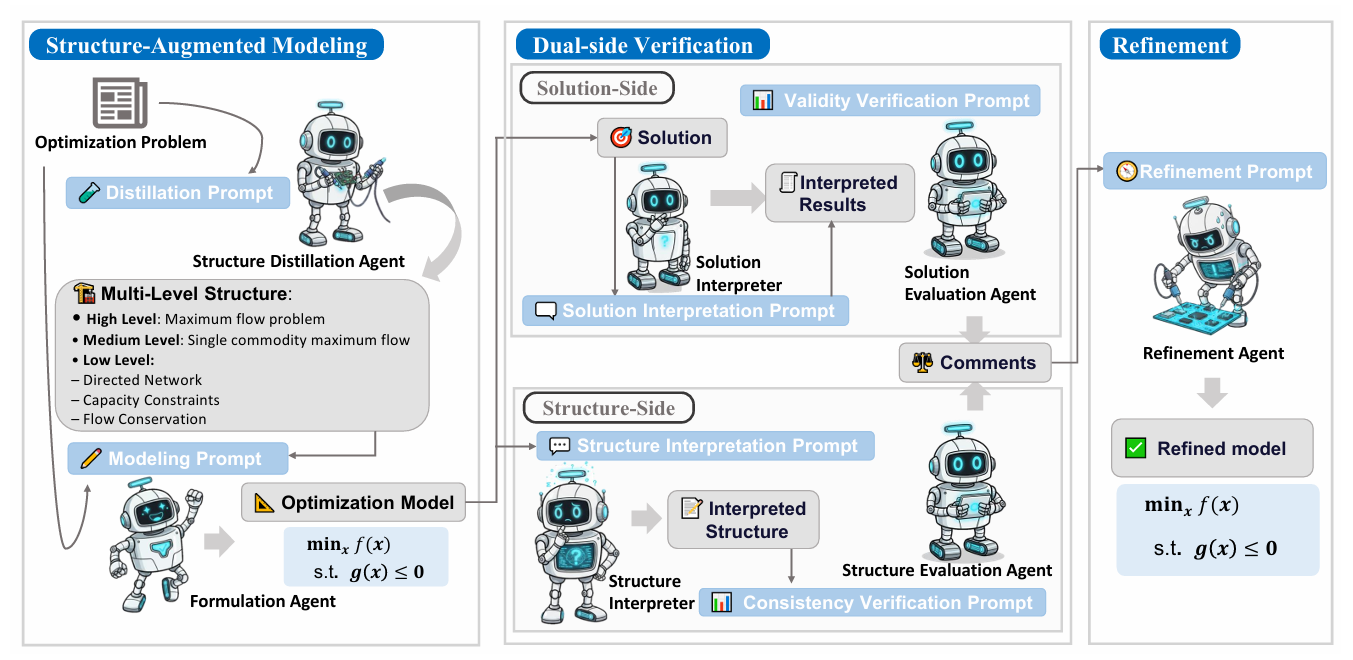
In the world of optimization, code that runs without errors is not always correct. A model might compile perfectly but still fail to solve the actual business problem. OptOne addresses this with Opt-Verifier, a rigorous double-check system. First, it performs a Structural Check: it translates the generated mathematical formulas back into plain English and compares them against your original requirements to ensure no rules were missed or misunderstood. Second, it runs a Solution Check: it executes the model and analyzes the results to catch logical absurdities—such as vehicles traveling negative distances or fulfilling orders with zero inventory. This feedback loop allows OptOne to automatically detect and fix its own mistakes, ensuring the final solution is not just valid code, but a correct decision.
Demo
Experience the real-time performance of OptOne. In this end-to-end demonstration, we open the “black box” of automated modeling to show you exactly how our agent thinks. The video presents a complete walkthrough of a complex multi-stage supply chain problem—a task that typically demands hours of human expert analysis, now solved in minutes.
Impact and Future Horizon
By integrating these five core technologies, OptOne evolves from a simple tool into a reliable collaborative partner. Its performance is proven: across major benchmarks like IndustryOR, OptMATH, and MAMO, OptOne consistently outperforms leading models. It excels particularly in hard scenarios—difficult problems that typically cause standard LLMs to fail.
The real-world impact is profound. OptOne makes expert-level optimization accessible to all, transforming industries from supply chain management to finance. It reduces the time required for modeling from weeks of human effort to just minutes of automated computation. As we look ahead, OptOne represents the true future of AI for Science: a future where AI agents do not merely chat, but reason, research, and solve the world’s toughest challenges with precision.
Series Work: The Foundation of OptOne
Our architecture is built upon five groundbreaking research papers, each addressing a critical bottleneck in the application of LLMs to industrial operations research.
[1] “OptiTree: Hierarchical Thoughts Generation with Tree Search for LLM Optimization Modeling”. Accepted by NeurIPS 2025
[2] “Opt-Miner: Empowering Information-Seeking Agent with Tree-Guided Data Synthesis for Optimization Modeling”. ICML 2026, Under Review
[3] “OptClimber: Climbing from Easy to Hard with Curriculum Experience Learning for LLM Optimization Modeling”. ICML 2026, Under Review
[4] “Opt-Aligner: Two-Stage Experience Transfer via Cognitive Alignment for Optimization Modeling”. ICML 2026, Under Review
[5] “Opt-Verifier: Unleashing the Power of LLMs for Optimization Modeling via Dual-Side Verification”. ICML 2026, Under Review
[6] The Data generation and Selection Pipeline: OptArena. Ongoing